

Your GTM Is Not Broken. It Was Never Designed
Why B2B companies keep fixing campaigns when the real problem is a missing revenue system.
The critical flaw holding B2B companies back isn’t a broken go-to-market strategy – it’s the absence of one that was ever intentionally built. This document challenges the dominant assumption that GTM failures are execution problems, and reveals them for what they truly are: design problems rooted in a fundamental lack of systematic, intentional architecture from day one.
- 72% GTM Targets Missed: Of B2B companies fail to meet GTM plan targets within their first year, according to CB Insights data.
- 90 Days to Operationalize: A framework that can’t be operationalized within 90 days is a slide deck – not a strategy.
- 1 Root Cause: Lack of intentional, systematic design from the ground up – not poor execution of a flawed plan.
The Illusion of a "Broken" GTM Strategy
When pipeline dries up, when CAC balloons, when sales and marketing teams point fingers across the table – the instinctive diagnosis is always the same: something is broken. But “broken” is a dangerous word. It implies that a sound system exists beneath the surface, waiting to be repaired. In reality, for the vast majority of B2B companies, no such system was ever built.
The moment a company accepts “broken” as the diagnosis, it embarks on a cycle of tactical fixes – new sales hires, fresh messaging, another channel pivot – none of which address the structural void underneath. The true culprit is upstream: a strategy that was never designed as a system in the first place. Fixing surface symptoms without addressing foundational design is not a strategy; it is expensive trial and error dressed in business language.
The "Aspirational Fiction" of GTM Planning
Open almost any GTM document at a B2B startup or growth-stage company, and you will find a familiar sequence: define the ICP, craft the messaging, select the channels, set the revenue targets, and then, implicitly, assume that revenue will follow. These documents are extraordinarily confident about inputs and almost completely silent about the mechanisms that convert those inputs into actual pipeline. They are, in essence, aspirational fiction.
The gap between a polished strategy deck and a functioning revenue engine is not a planning gap. It is a design gap. Planning asks “what will we do?” Design asks “how will this actually work in the hands of real salespeople, real marketers, and real buyers with limited attention and competing priorities?” Most GTM documents answer the first question with great detail and never seriously engage with the second.
A framework that cannot be operationalized within 90 days is a slide deck, not a strategy. The test of any GTM plan is not whether it is logically coherent – it is whether it connects to real buying activity inside a quarter.
The execution problem that leaders spend so much time diagnosing is almost always a design problem in disguise. When messaging doesn’t land, it is rarely because the words are wrong, it is because the messaging was never stress-tested against how real buyers actually talk about their problems. When channels underperform, it is rarely bad targeting, it is because the channel selection was never grounded in evidence about where the ICP actually makes purchasing decisions. Aspirational planning produces aspirational results.
Build the GTM System You Never Had
Stop layering tactics on a missing foundation. Build a revenue system that actually converts effort into pipeline.
The Cost of Guesswork: When Assumptions Drive Strategy
Every GTM strategy begins with assumptions. That is unavoidable. The question is whether those assumptions are treated as hypotheses to be tested or axioms to be built upon. When organizations build revenue infrastructure on top of untested assumptions, they are not building a strategy – they are constructing an elaborate bet, and the house always wins.
| Assumption-Driven GTM | Data-Driven GTM Design |
|---|---|
| Generic TAM calculations that feel large and confident | Bottoms-up TAM built from analysis of best existing customers |
| ICP built from internal brainstorms, not customer data | ICP defined by behavioral signals and verified buying patterns |
| Messaging crafted around product features, not buyer outcomes | Messaging validated against how customers describe their own pain |
| Channel selection based on what competitors appear to be doing | Channel selection grounded in evidence of where ICP buys |
| Pipeline targets reverse-engineered from financial models | Pipeline targets built from conversion rate reality, not aspiration |
The critical first step in intentional GTM design is replacing assumptions with data – not just aspirational statements dressed in data’s clothing. Generic total addressable market calculations that produce impressive-looking numbers are functionally useless for guiding resource allocation. What matters is a bottoms-up approach: analyzing your best current customers, understanding what made them convert and stay, and building your GTM around replicating that motion at scale. Strategies built on assumptions generate pipeline built on hope. Hope is not a revenue system.
The Missing Blueprint: Why Silos Lead to Failure
Building and launching a product or service without a coherent GTM framework is the organizational equivalent of constructing a house without architectural drawings. You might end up with four walls and a roof, but the plumbing will run into the electrical, the load-bearing walls will be in the wrong places, and the foundation will be undersized for what sits above it. The structure stands until it doesn’t – and by then, the cost of remediation is catastrophic.
- The Silo Problem: When sales, marketing, product, and customer success operate independently, each team optimizes for its own metrics. The result is mixed messages in the market, redundant spend, and a buyer experience that feels disjointed.
- The Alignment Imperative: A solid GTM framework creates shared language, priorities, and accountability. Efforts compound rather than cancel. Each team’s work creates leverage for others, ensuring a coherent, trustworthy brand experience.
- The Blueprint Advantage: Intentional design means deciding in advance how each function connects. We map marketing output to sales usage and product signals to CS monitors, all back to a single, articulable revenue thesis.
The damage from siloed GTM execution compounds invisibly at first. Prospects receive one message from an ad, a different one from a sales rep, and yet another from a trial experience – and they quietly move on to a competitor whose story is consistent. Wasted spend is painful but visible; confused buyers are invisible until they show up in a churned ARR report months later.
GTM as a Revenue Operating System
The most persistent and damaging confusion in B2B go-to-market is the conflation of a marketing plan with a GTM strategy. A marketing plan is a timeline of activities: campaigns to launch, content to produce, events to attend, ads to run. It answers the question “what will we do and when?” A GTM strategy is something fundamentally different.
- Marketing Plan
- A calendar of activities. Campaigns, content, events. Tells the team what to do and when.
- GTM Strategy
- The why and how behind the activities. The mechanism connecting effort to revenue outcome.
- Revenue OS
- GTM at its best: a unified operating system connecting sales, marketing, product, and CS across the full customer journey.
At its highest expression, a GTM strategy functions as a revenue operating system, a unified set of principles, processes, and feedback loops that connect sales, marketing, product, and customer success into a single, coherent motion. It is not a function of any one department. It is the operating logic of the entire customer-facing organization. It covers the full customer journey: from the moment a buyer first realizes they have a problem worth solving, through the decision to act, through the purchase and onboarding, through sustained value delivery and expansion.
Most organizations have pieces of this. They have marketing campaigns. They have a sales process. They have onboarding flows. What they rarely have is the connective tissue, the intentional design that ensures each piece hands off cleanly to the next, that defines what a “good” lead looks like before it enters sales, that specifies what “success” means at 30, 60, and 90 days post-close. That connective tissue is not created by accident. It is designed.
The Foundation of Intentional Design: Defining the Real Problem
The most upstream failure point in GTM design is also the most overlooked: misdiagnosis of the customer problem. Organizations spend enormous energy crafting messaging and building sales playbooks before they have genuinely understood – in the customer’s own words, from the customer’s own lived experience – what problem their product actually solves and why that problem is urgent enough to justify a purchase.
"The customer does not buy your product. They buy a version of their future in which a painful problem no longer exists. Your GTM must be designed around that future, not around your feature set."
The failure mode is predictable: teams describe customer problems in product terms. “They need simpler onboarding.” “They need better reporting.” “They need faster integration.” These are product descriptions, not problem articulations. Customers do not wake up thinking about onboarding complexity. They wake up thinking about the fact that new hires are taking three months to become productive, and that they just lost a deal because their team didn’t have the right information at the right moment. Those are the problems. The product is just one possible solution.
Problem articulation must be grounded in how customers experience the problem today – not in how the product team has described the solution internally. This requires qualitative research: customer interviews, win/loss analysis, and careful attention to the language buyers use when they are not trying to be polite. The gap between how companies describe customer problems and how customers actually experience them is often the entire gap between a GTM that generates pipeline and one that generates activity with no commercial consequence.
Beyond Categories: Identifying Your True Ideal Customer Profile
The ICP exercise is foundational to every GTM strategy, and it is almost universally executed too broadly to be useful. “SMBs in North America.” “Mid-market SaaS companies.” “Enterprise financial services firms.” These are categories, not profiles. They describe buckets of companies that share a firmographic characteristic. They say nothing about which of those companies are actually ready to buy, what makes them convert, or how to identify them before a competitor does.
The modern ICP must be defined by behavior, not by firmographics alone. What does a ready-to-buy customer actually do before they buy? What tools do they use adjacent to yours? What events trigger their search process? What content do they consume, and what does that consumption pattern reveal about the urgency and sophistication of their need? Segmenting by content interaction patterns, adjacent tooling in the tech stack, workflow context, and AI-inferred intent allows a GTM team to identify high-probability prospects before those prospects have self-identified, and to reach them with messaging that feels uncannily relevant rather than generically targeted.
The practical implication is significant: an ICP defined with behavioral precision changes everything downstream. It changes which accounts sales prioritizes, which content marketing produces, which channels are worth investing in, and how outbound sequences are structured. A broad ICP produces broad, inefficient GTM motion. A behaviorally precise ICP produces a focused, compounding revenue engine where every dollar and every hour of effort is directed at the highest-probability opportunities in the market.
The 90-Day Framework: From Analysis to Actionable Pipeline
Intentional GTM design is not an abstract philosophy – it is a concrete, time-bounded process. A strategy that cannot be executed within 90 days is not a strategy; it is a vision document. The 90-day framework translates the principles of intentional design into a structured sequence of activities that connects organizational capability to real buying activity in a single quarter.
- 01. Market Analysis: We dive deep into your current market position, identifying hidden gaps and competitive advantages to build a foundation based on real-world data.
- 02. Strategy Design: Transforming insights into an actionable roadmap. We define the “why” and “how” behind your GTM efforts to ensure every dollar spent drives revenue.
- 03. Execution Build: Setting up the infrastructure. We align your sales, marketing, and CS teams through a unified operating system that eliminates friction.
- 04. Launch & Iterate: Going live with a systematic approach. We monitor adoption signals and product usage to continuously optimize and scale your growth.
Each phase of the framework answers a distinct set of questions. Market Analysis answers: who exactly is our buyer, what do they actually care about, and why do they choose or reject solutions like ours? Strategy Design answers: where will we play, how will we win, and what will we say and to whom? Execution Build answers: what does each team member do on Monday morning, and how do we know if it is working? Launch and Iterate answers: what are we learning from real market contact, and how quickly can we incorporate that learning into our next cycle?
The key differentiator of the 90-day framework is the final phase: Launch and Iterate. Most GTM plans treat launch as a destination. Intentional GTM design treats launch as the beginning of a learning loop. The goal is not a perfect plan executed flawlessly. The goal is a structured experiment that generates real signal from real buyers, quickly enough to course-correct within the same quarter. That distinction – between a static plan and a dynamic learning system – is the difference between a GTM strategy and a revenue operating system.
The 90-day framework is not a shortcut – it is a commitment to connecting strategy to buying reality faster than your competitors do.
Conclusion: Building for Success, Not Just Launching
The most important reframe in go-to-market strategy is deceptively simple: a GTM strategy is not a document. It is a system – a deliberate, interconnected architecture of decisions about where to compete, how to win, and how to sustain that winning as the market evolves. Documents get filed. Systems get executed, iterated, and improved. The companies that consistently hit their revenue targets are not the ones with the most polished decks – they are the ones that built the most intentional systems.
- Data Over Assumptions: Replace aspirational inputs with evidence from real customers, real buying patterns, and real market signals. Every strategic decision earns its place through data.
- Cross-Functional Alignment: Sustainable revenue growth is impossible without shared language, shared priorities, and shared accountability across sales, marketing, product, and customer success.
- Intentional Design: Stop launching and hoping. Start designing: define the system before you activate it, and build feedback loops that make it smarter with every cycle.
The companies stuck in a cycle of GTM “fixes” are not suffering from bad execution. They are suffering from the consequences of never having built a system in the first place. Every new hire, every new channel, every new messaging framework applied to a structurally unsound foundation produces incremental motion at best, and expensive confusion at worst. The fix is not another fix. The fix is a rebuild – intentional, data-driven, cross-functionally aligned, and designed to learn faster than the market changes.
Stop diagnosing your GTM as broken. Start asking whether it was ever designed. The answer, for most companies, is the beginning of a real strategy.
The bar for GTM success has never been higher. Buyers are more informed, more skeptical, and more selective than at any previous moment in the B2B buying cycle. The organizations that will win are not the ones that move fastest – they are the ones that move most intentionally. Build your GTM like you mean it. Design it like revenue depends on it. Because it does.
The critical flaw holding B2B companies back isn’t a broken go-to-market strategy – it’s the absence of one that was ever intentionally built. This document challenges the dominant assumption that GTM failures are execution problems, and reveals them for what they truly are: design problems rooted in a fundamental lack of systematic, intentional architecture from day one.
The Illusion of a "Broken" GTM Strategy
When pipeline dries up, when CAC balloons, when sales and marketing teams point fingers across the table – the instinctive diagnosis is always the same: something is broken. But “broken” is a dangerous word. It implies that a sound system exists beneath the surface, waiting to be repaired. In reality, for the vast majority of B2B companies, no such system was ever built.
The moment a company accepts “broken” as the diagnosis, it embarks on a cycle of tactical fixes – new sales hires, fresh messaging, another channel pivot – none of which address the structural void underneath. The true culprit is upstream: a strategy that was never designed as a system in the first place. Fixing surface symptoms without addressing foundational design is not a strategy; it is expensive trial and error dressed in business language.
The "Aspirational Fiction" of GTM Planning
Open almost any GTM document at a B2B startup or growth-stage company, and you will find a familiar sequence: define the ICP, craft the messaging, select the channels, set the revenue targets, and then, implicitly, assume that revenue will follow. These documents are extraordinarily confident about inputs and almost completely silent about the mechanisms that convert those inputs into actual pipeline. They are, in essence, aspirational fiction.
The gap between a polished strategy deck and a functioning revenue engine is not a planning gap. It is a design gap. Planning asks “what will we do?” Design asks “how will this actually work in the hands of real salespeople, real marketers, and real buyers with limited attention and competing priorities?” Most GTM documents answer the first question with great detail and never seriously engage with the second.
A framework that cannot be operationalized within 90 days is a slide deck, not a strategy. The test of any GTM plan is not whether it is logically coherent – it is whether it connects to real buying activity inside a quarter.
The execution problem that leaders spend so much time diagnosing is almost always a design problem in disguise. When messaging doesn’t land, it is rarely because the words are wrong, it is because the messaging was never stress-tested against how real buyers actually talk about their problems. When channels underperform, it is rarely bad targeting, it is because the channel selection was never grounded in evidence about where the ICP actually makes purchasing decisions. Aspirational planning produces aspirational results.
Build the GTM System You Never Had
Stop layering tactics on a missing foundation. Build a revenue system that actually converts effort into pipeline.
The Cost of Guesswork: When Assumptions Drive Strategy
Every GTM strategy begins with assumptions. That is unavoidable. The question is whether those assumptions are treated as hypotheses to be tested or axioms to be built upon. When organizations build revenue infrastructure on top of untested assumptions, they are not building a strategy – they are constructing an elaborate bet, and the house always wins.
Assumption-Driven GTM
- Generic TAM calculations that feel large and confident
- ICP built from internal brainstorms, not customer data
- Messaging crafted around product features, not buyer outcomes
- Channel selection based on what competitors appear to be doing
- Pipeline targets reverse-engineered from financial models
Data-Driven GTM Design
- Bottoms-up TAM built from analysis of best existing customers
- ICP defined by behavioral signals and verified buying patterns
- Messaging validated against how customers describe their own pain
- Channel selection grounded in evidence of where ICP buys
- Pipeline targets built from conversion rate reality, not aspiration
The critical first step in intentional GTM design is replacing assumptions with data – not just aspirational statements dressed in data’s clothing. Generic total addressable market calculations that produce impressive-looking numbers are functionally useless for guiding resource allocation. What matters is a bottoms-up approach: analyzing your best current customers, understanding what made them convert and stay, and building your GTM around replicating that motion at scale. Strategies built on assumptions generate pipeline built on hope. Hope is not a revenue system.
The Missing Blueprint: Why Silos Lead to Failure
Building and launching a product or service without a coherent GTM framework is the organizational equivalent of constructing a house without architectural drawings. You might end up with four walls and a roof, but the plumbing will run into the electrical, the load-bearing walls will be in the wrong places, and the foundation will be undersized for what sits above it. The structure stands until it doesn’t – and by then, the cost of remediation is catastrophic.
The Silo Problem
When sales, marketing, product, and customer success operate independently, each team optimizes for its own metrics. The result is mixed messages in the market, redundant spend, and a buyer experience that feels disjointed.
The Alignment Imperative
A solid GTM framework creates shared language, priorities, and accountability. Efforts compound rather than cancel. Each team’s work creates leverage for others, ensuring a coherent, trustworthy brand experience.
The Blueprint Advantage
Intentional design means deciding in advance how each function connects. We map marketing output to sales usage and product signals to CS monitors, all back to a single, articulable revenue thesis.
The damage from siloed GTM execution compounds invisibly at first. Prospects receive one message from an ad, a different one from a sales rep, and yet another from a trial experience – and they quietly move on to a competitor whose story is consistent. Wasted spend is painful but visible; confused buyers are invisible until they show up in a churned ARR report months later.
GTM as a Revenue Operating System
The most persistent and damaging confusion in B2B go-to-market is the conflation of a marketing plan with a GTM strategy. A marketing plan is a timeline of activities: campaigns to launch, content to produce, events to attend, ads to run. It answers the question “what will we do and when?” A GTM strategy is something fundamentally different. It answers the questions “why will buyers choose us over alternatives, and how will we reach, convert, and retain them at scale?”
Marketing Plan
A calendar of activities. Campaigns, content, events. Tells the team what to do and when.
GTM Strategy
The why and how behind the activities. The mechanism connecting effort to revenue outcome.
Revenue OS
GTM at its best: a unified operating system connecting sales, marketing, product, and CS across the full customer journey.
At its highest expression, a GTM strategy functions as a revenue operating system, a unified set of principles, processes, and feedback loops that connect sales, marketing, product, and customer success into a single, coherent motion. It is not a function of any one department. It is the operating logic of the entire customer-facing organization. It covers the full customer journey: from the moment a buyer first realizes they have a problem worth solving, through the decision to act, through the purchase and onboarding, through sustained value delivery and expansion.
Most organizations have pieces of this. They have marketing campaigns. They have a sales process. They have onboarding flows. What they rarely have is the connective tissue, the intentional design that ensures each piece hands off cleanly to the next, that defines what a “good” lead looks like before it enters sales, that specifies what “success” means at 30, 60, and 90 days post-close. That connective tissue is not created by accident. It is designed.
The Foundation of Intentional Design: Defining the Real Problem
The most upstream failure point in GTM design is also the most overlooked: misdiagnosis of the customer problem. Organizations spend enormous energy crafting messaging and building sales playbooks before they have genuinely understood – in the customer’s own words, from the customer’s own lived experience – what problem their product actually solves and why that problem is urgent enough to justify a purchase.
The customer does not buy your product. They buy a version of their future in which a painful problem no longer exists. Your GTM must be designed around that future, not around your feature set.
The failure mode is predictable: teams describe customer problems in product terms. “They need simpler onboarding.” “They need better reporting.” “They need faster integration.” These are product descriptions, not problem articulations. Customers do not wake up thinking about onboarding complexity. They wake up thinking about the fact that new hires are taking three months to become productive, and that they just lost a deal because their team didn’t have the right information at the right moment. Those are the problems. The product is just one possible solution.
Problem articulation must be grounded in how customers experience the problem today – not in how the product team has described the solution internally. This requires qualitative research: customer interviews, win/loss analysis, and careful attention to the language buyers use when they are not trying to be polite. The gap between how companies describe customer problems and how customers actually experience them is often the entire gap between a GTM that generates pipeline and one that generates activity with no commercial consequence.
Beyond Categories: Identifying Your True Ideal Customer Profile
The ICP exercise is foundational to every GTM strategy, and it is almost universally executed too broadly to be useful. “SMBs in North America.” “Mid-market SaaS companies.” “Enterprise financial services firms.” These are categories, not profiles. They describe buckets of companies that share a firmographic characteristic. They say nothing about which of those companies are actually ready to buy, what makes them convert, or how to identify them before a competitor does.
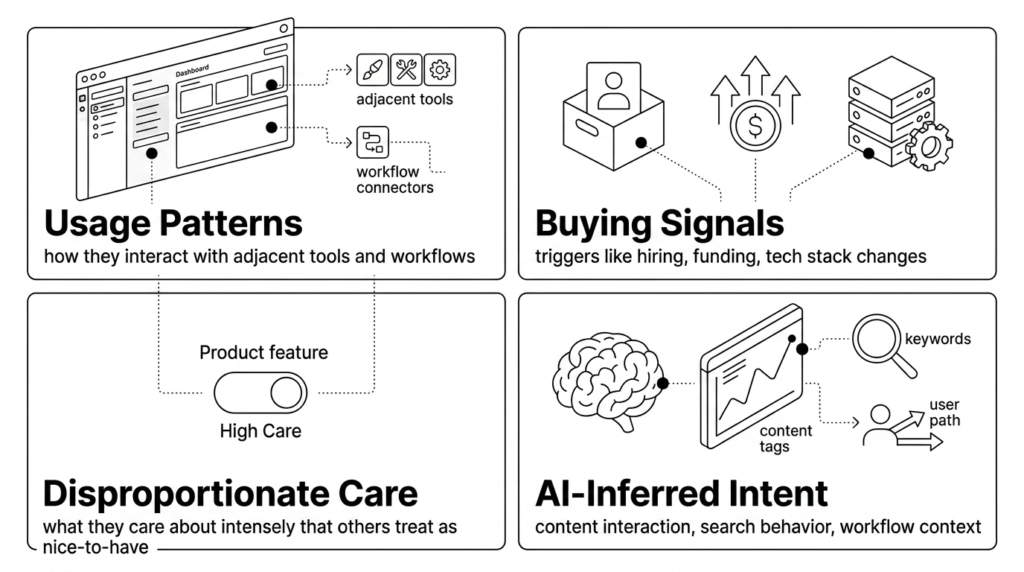
The modern ICP must be defined by behavior, not by firmographics alone. What does a ready-to-buy customer actually do before they buy? What tools do they use adjacent to yours? What events trigger their search process? What content do they consume, and what does that consumption pattern reveal about the urgency and sophistication of their need? Segmenting by content interaction patterns, adjacent tooling in the tech stack, workflow context, and AI-inferred intent allows a GTM team to identify high-probability prospects before those prospects have self-identified, and to reach them with messaging that feels uncannily relevant rather than generically targeted.
The practical implication is significant: an ICP defined with behavioral precision changes everything downstream. It changes which accounts sales prioritizes, which content marketing produces, which channels are worth investing in, and how outbound sequences are structured. A broad ICP produces broad, inefficient GTM motion. A behaviorally precise ICP produces a focused, compounding revenue engine where every dollar and every hour of effort is directed at the highest-probability opportunities in the market.
The 90-Day Framework: From Analysis to Actionable Pipeline
Intentional GTM design is not an abstract philosophy – it is a concrete, time-bounded process. A strategy that cannot be executed within 90 days is not a strategy; it is a vision document. The 90-day framework translates the principles of intentional design into a structured sequence of activities that connects organizational capability to real buying activity in a single quarter.
01. Market Analysis
We dive deep into your current market position, identifying hidden gaps and competitive advantages to build a foundation based on real-world data.
02. Strategy Design
Transforming insights into an actionable roadmap. We define the “why” and “how” behind your GTM efforts to ensure every dollar spent drives revenue.
03. Execution Build
Setting up the infrastructure. We align your sales, marketing, and CS teams through a unified operating system that eliminates friction.
04. Launch & Iterate
Going live with a systematic approach. We monitor adoption signals and product usage to continuously optimize and scale your growth.
Each phase of the framework answers a distinct set of questions. Market Analysis answers: who exactly is our buyer, what do they actually care about, and why do they choose or reject solutions like ours? Strategy Design answers: where will we play, how will we win, and what will we say and to whom? Execution Build answers: what does each team member do on Monday morning, and how do we know if it is working? Launch and Iterate answers: what are we learning from real market contact, and how quickly can we incorporate that learning into our next cycle?
The key differentiator of the 90-day framework is the final phase: Launch and Iterate. Most GTM plans treat launch as a destination. Intentional GTM design treats launch as the beginning of a learning loop. The goal is not a perfect plan executed flawlessly. The goal is a structured experiment that generates real signal from real buyers, quickly enough to course-correct within the same quarter. That distinction – between a static plan and a dynamic learning system – is the difference between a GTM strategy and a revenue operating system.
The 90-day framework is not a shortcut – it is a commitment to connecting strategy to buying reality faster than your competitors do.
Conclusion: Building for Success, Not Just Launching
The most important reframe in go-to-market strategy is deceptively simple: a GTM strategy is not a document. It is a system – a deliberate, interconnected architecture of decisions about where to compete, how to win, and how to sustain that winning as the market evolves. Documents get filed. Systems get executed, iterated, and improved. The companies that consistently hit their revenue targets are not the ones with the most polished decks – they are the ones that built the most intentional systems.
Data Over Assumptions
Replace aspirational inputs with evidence from real customers, real buying patterns, and real market signals. Every strategic decision earns its place through data.
Cross-Functional Alignment
Sustainable revenue growth is impossible without shared language, shared priorities, and shared accountability across sales, marketing, product, and customer success.
Intentional Design
Stop launching and hoping. Start designing: define the system before you activate it, and build feedback loops that make it smarter with every cycle.
The companies stuck in a cycle of GTM “fixes” are not suffering from bad execution. They are suffering from the consequences of never having built a system in the first place. Every new hire, every new channel, every new messaging framework applied to a structurally unsound foundation produces incremental motion at best, and expensive confusion at worst. The fix is not another fix. The fix is a rebuild – intentional, data-driven, cross-functionally aligned, and designed to learn faster than the market changes.
Stop diagnosing your GTM as broken. Start asking whether it was ever designed. The answer, for most companies, is the beginning of a real strategy.
The bar for GTM success has never been higher. Buyers are more informed, more skeptical, and more selective than at any previous moment in the B2B buying cycle. The organizations that will win are not the ones that move fastest – they are the ones that move most intentionally. Build your GTM like you mean it. Design it like revenue depends on it. Because it does.
Turn Your Strategy Into a Revenue Engine
Connect your ICP, messaging, channels, and execution into one unified GTM engine.
“Your GTM isn’t broken, it was never built as a system. When strategy lives in slides instead of infrastructure, every tactic becomes guesswork. Revenue does not scale through effort alone, it scales through intentional design.”