

Your pipeline is stalling. Your CAC is climbing. Your board wants answers. But the data you’re relying on to make growth decisions is fundamentally broken. Last-click attribution is not a measurement strategy. It is a revenue liability, and it is quietly dismantling the demand engine you have spent years building.
This piece challenges a dangerous assumption baked into most B2B SaaS marketing stacks: that the last touchpoint before conversion deserves full credit for the sale. It does not. And the cost of believing otherwise is measured in misallocated budgets, undervalued content, and compounding growth stalls.
Why Broken Attribution Is Killing Pipeline Growth
Most B2B SaaS companies are not failing due to a lack of marketing activity. They are failing because their attribution infrastructure is broken. Last-click models systematically undervalue demand generation, distort budget allocation, and manufacture false ROI signals that drive the wrong decisions at every level.
The Core Problem
Last-click attribution over-credits bottom-funnel actions and ignores the upstream demand engine driving pipeline.
The Real Impact
Poor budget decisions, underinvestment in brand and content, rising CAC, and disconnected revenue systems.
The Reframe
Attribution is not a reporting issue. It is a Revenue Architecture problem that demands a system-level solution.
The Path Forward
Multi-touch attribution tied to pipeline velocity, deal acceleration, and revenue outcomes, not isolated conversion events.
The Last-Click Illusion: What You Think You Know Is Wrong
Last-click attribution is seductive in its simplicity. A prospect clicks a paid search ad, fills out a demo form, and closes 90 days later. The model celebrates the ad. The attribution report declares victory. The budget flows to paid search. But here is what that model never tells you: that same prospect read six blog posts over four months, attended a webinar, consumed a competitor comparison page, and received three nurture emails before that final click ever happened.
Every touchpoint upstream did the heavy lifting. Last-click got the trophy. This is not a minor measurement gap. It is a systematic distortion that compounds with every budget cycle, every campaign decision, and every executive review where incomplete data drives confident, wrong conclusions.
How the Model Works Against You
The damage is not random. It follows a predictable pattern: compress measurement to the last event, reward only what is measurable at the bottom of the funnel, defund everything that builds awareness and trust upstream, and watch pipeline quality deteriorate over the next two to four quarters. This is not a marketing problem. It is a structural feedback loop that punishes long-term demand creation in favor of short-term conversion optics.
Five Ways Last-Click Attribution Distorts Budget Allocation

The Hidden Demand Engine You Are Actively Defunding
Every B2B SaaS buying decision involves an average of six to ten stakeholders consuming content across eight to twelve touchpoints before a commercial conversation begins. The entire first two-thirds of that journey is invisible to last-click attribution. You are measuring the tip of the iceberg and making decisions about the whole glacier.
The upstream demand engine, meaning the content, community, thought leadership, organic search presence, and brand awareness that prime buyers for your category, is the compounding asset that makes every paid channel more efficient. When you defund it because it cannot claim last-click credit, you are not just losing content ROI. You are increasing the cost and difficulty of every conversion downstream. CAC climbs. Sales cycles lengthen. Pipeline quality deteriorates. And the attribution model never explains why, because it was never designed to see what it destroyed.
The CAC Problem No One Is Connecting to Attribution
Why CAC Keeps Rising
When demand generation is defunded in favor of bottom-funnel capture, the pipeline eventually thins. Sales responds by increasing outbound volume. Marketing increases paid spend to maintain lead flow. Both cost more per opportunity created.
The real driver of rising CAC is the slow collapse of the inbound demand engine. Fewer prospects arrive already educated and intent-ready. Sales cycles lengthen because buyers lack the upstream content touchpoints that normally accelerate conviction.
Average deal size compresses as less-qualified, lower-intent leads fill the pipeline.
The Attribution–CAC Feedback Loop
Defund upstream demand. Bottom-funnel efficiency appears to hold. Pipeline quality silently drops. Sales cycle length increases. CAC rises. Board demands efficiency cuts. More upstream demand gets defunded. Repeat.
This cycle is almost impossible to break without first fixing the measurement infrastructure.
Until attribution reflects true influence across the journey, investment decisions will continue optimizing for short-term efficiency at the cost of long-term revenue growth.
Attribution Failure Is a Revenue Architecture Problem
Here is the reframe that changes everything: last-click attribution is not a reporting problem. It is not a marketing ops problem. It is a Revenue Architecture failure. When marketing, sales, and RevOps operate with disconnected measurement systems, attribution gaps are not just analytical inconveniences. They become the source code for misaligned strategy, broken budget decisions, and uncoordinated go-to-market execution.
Fix Your Attribution Before It Costs You Revenue
If your data is crediting the wrong channels, your entire budget strategy is flawed.
Introducing Multi-Touch Attribution: A System-Level Approach
Multi-touch attribution distributes credit across all the touchpoints that influenced a buyer’s journey, giving marketing teams the signal they need to understand not just what converted, but what created, accelerated, and sustained the buying decision from first awareness to closed revenue.
This is not simply a different attribution model. It is the foundation of a system-level measurement approach that connects demand generation activity to pipeline creation, pipeline to deal velocity, and deal velocity to revenue outcomes. For B2B SaaS leaders, this shift transforms attribution from a backward-looking dashboard metric into a forward-looking strategic lever.
Multi-Touch Model Comparison
Not all multi-touch models are created equal. Choosing the right attribution framework depends on your sales cycle length, data maturity, and the specific decisions you need to drive. The table below maps each model to its highest-value use case for B2B SaaS.
| Model | How It Works | Best For | Key Limitation |
|---|---|---|---|
| Last-Click | 100% credit to final touchpoint before conversion | Short, transactional cycles only | Blind to entire upstream demand engine |
| Linear | Equal credit distributed across all touchpoints | Building baseline multi-touch visibility | Does not reflect actual influence weight |
| Time Decay | More credit to touchpoints closer to conversion | High-velocity sales cycles | Still undervalues top-of-funnel demand creation |
| U-Shaped (Position Based) | 40% first touch, 40% lead creation, 20% middle | Demand gen plus conversion measurement | Middle-funnel acceleration still underweighted |
| W-Shaped | Weights first touch, lead, and opportunity creation | Full-funnel B2B pipeline measurement | Requires clean CRM data and stage definitions |
| Algorithmic / Data-Driven | ML-based weighting from actual revenue outcomes | Mature stacks with sufficient data volume | Requires significant historical data and expertise |
The Revenue Architecture Framework
Fixing attribution is not the end goal. It is the entry point to building a Revenue Architecture that connects every system, team, and measurement layer into a unified view of how demand becomes revenue. This framework has three interconnected layers.
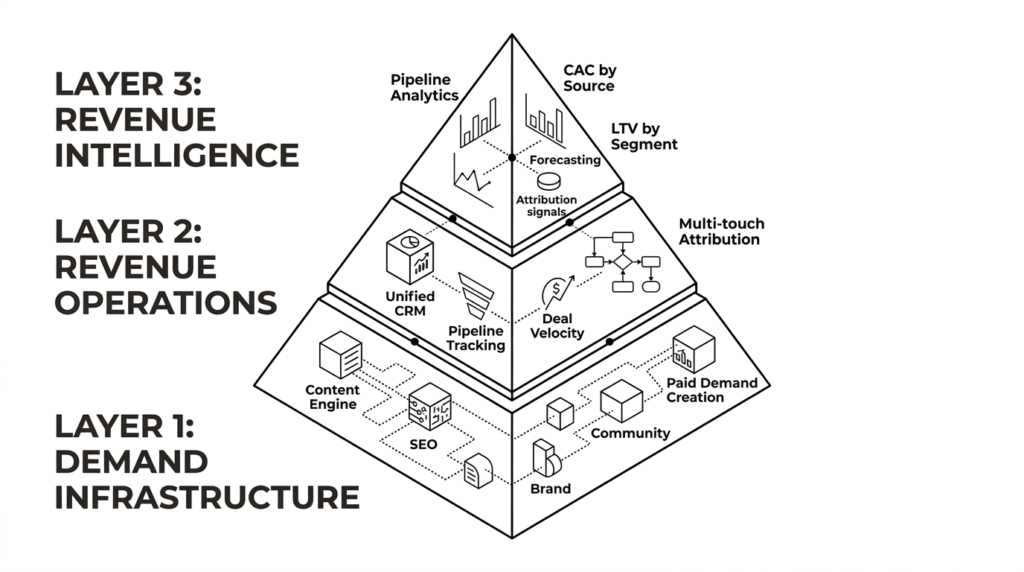
Each layer must be built before the next becomes meaningful. Demand infrastructure creates the pipeline signal. Revenue operations captures and connects it. Revenue intelligence interprets it and drives strategic decisions. Organizations that skip the foundation and jump to intelligence end up building dashboards on top of broken data, which is precisely where most B2B SaaS companies are stuck today.
What This Means for Founders and Revenue Leaders
If you are a founder or CEO, the message is direct: the data your marketing team brings to the budget conversation is probably incomplete in ways that compound over time. The channels getting funded are likely not the ones building sustainable pipeline. The channels getting cut are probably the invisible foundation of your entire demand engine.
If you are a CMO, last-click attribution is not protecting your budget. It is making your highest-value work unmeasurable and therefore unjustifiable. The solution is not to argue louder for brand investment. It is to build the measurement infrastructure that makes upstream demand creation visible in the language of revenue.
If you are a RevOps leader, attribution is your problem to solve. The integration of marketing touchpoint data with pipeline stages and revenue outcomes is the technical and strategic challenge that unlocks everything else. This is not a tool purchase. It is an architectural decision that will define how your entire go-to-market system learns and improves.
The Implementation Roadmap
Key Metrics to Replace Last-Click Vanity Numbers

8–12
Average Touchpoints
The number of meaningful buyer interactions in a typical enterprise B2B deal that last-click attribution collapses into one.
3–6×
Pipeline Influence
The multiplier effect that properly attributed content and brand touchpoints show on pipeline creation when measured with multi-touch models.
40%+
CAC Reduction Potential
Average CAC improvement B2B SaaS companies report when they reinvest in upstream demand channels identified through multi-touch attribution.
6+
Stakeholders per Deal
The average buying committee size in enterprise SaaS deals, each with their own touchpoint journey that single-touch models cannot capture.
These are the numbers that matter. Not MQL volume. Not last-click conversion rate. Not cost-per-lead from a channel that was simply capturing demand your upstream engine already built. Pipeline influence, deal velocity, and revenue-connected CAC are the metrics that separate revenue architects from marketing tacticians.
The Strategic Shift: From Reporting to Revenue Architecture
Stop Measuring This Way
- Last-click conversion rate by channel
- MQL volume as a primary success metric
- Cost-per-lead without pipeline quality context
- Channel ROI in isolation from full buyer journey
- Attribution as a marketing reporting function
Start Measuring This Way
- Pipeline creation influenced by channel and content
- Deal velocity by touchpoint sequence and frequency
- CAC by first-touch source and multi-touch influence
- Revenue per channel accounting for full journey contribution
- Attribution as a Revenue Architecture strategic input
Build a Revenue-Connected Measurement System
Move beyond last-click and connect marketing, pipeline, and revenue into one system.
Last-click attribution doesn’t just mismeasure performance—it rewires your strategy. When only the final touch gets credit, you systematically defund the demand engine that actually creates pipeline and drives long-term revenue.