

Growth Architecture Design is the foundation of a scalable revenue system for B2B SaaS in 2026. This blueprint unifies ICP definition, demand generation, deal acceleration, and revenue operations into one connected, compounding engine. Stop running fragmented campaigns. Start building infrastructure that scales predictably and delivers measurable revenue outcomes year over year.
What Is Revenue Architecture and Why It Matters in 2026
Revenue Architecture is not a marketing strategy or a sales playbook. It is the deliberate design of every system, process, signal, and team motion that converts market attention into repeatable, predictable revenue. In 2026, B2B SaaS companies face a fundamentally different growth environment than even three years ago. Buyers are more informed, sales cycles are longer, and the cost of acquiring new customers has risen sharply across nearly every category.
The era of growth-at-all-costs is over. Capital-efficient revenue generation is now the defining competitive advantage. Companies that built their go-to-market on paid acquisition spikes, SDR volume, and disconnected point solutions are experiencing compressing margins and unpredictable pipelines. The ones winning are those that have invested in architecture, not just activity.
Revenue Architecture treats your entire go-to-market as an interconnected system. It means your ICP definition informs your content strategy, which fuels your demand engine, which feeds a qualified pipeline, which sales accelerates with precision, and which RevOps measures and optimizes across every stage. Nothing operates in isolation. Every motion reinforces the next. The result is a flywheel that gets more efficient over time rather than requiring ever-increasing spend to maintain output.
This blueprint walks through each layer of that architecture in sequence. Whether you are a founder building your first repeatable motion or a revenue leader rebuilding a broken system, the five pillars outlined here provide the structural framework for sustainable, compounding SaaS growth.
Precision Over Volume
Target fewer, better-fit accounts to increase win rates and reduce wasted CAC across every funnel stage.
Systems Over Campaigns
Build infrastructure that compounds over time instead of running one-off campaigns that spike and fade.
Alignment Over Silos
Connect marketing, sales, and operations into a single revenue system with shared goals and clean data.
Measurement Over Intuition
Replace gut-feel decisions with attribution models and pipeline analytics that drive confident investment.
The Four Pillars of Revenue Architecture
A complete Revenue Architecture for B2B SaaS is built on four interconnected pillars. Each one depends on the others. Skipping a layer or executing it weakly creates bottlenecks that cap your growth ceiling regardless of how well you execute elsewhere. Understanding the full blueprint before diving into each pillar ensures every design decision you make reinforces the whole system.
These four pillars form a linear progression that also operates as a feedback loop. Your ICP definition sharpens as RevOps data reveals which customer segments deliver the highest lifetime value and fastest time-to-value. Your demand engine improves as deal acceleration insights reveal which content and channels produce the most qualified buyers. The system gets smarter with every cycle, compounding returns on every investment you make in its architecture.
Fix the Foundation Before You Scale
From ICP clarity to RevOps alignment, we identify what is limiting your growth.
Pillar 1: Define Your Ideal Customer Profile with Precision
The ICP is not a demographic description. It is a dynamic, data-backed definition of the specific company characteristics, buying triggers, and stakeholder configurations that produce your best customers. Getting this wrong is the single most expensive mistake a B2B SaaS company can make. Every downstream motion, from demand generation to deal acceleration, is only as effective as the precision of the ICP it is built around.
Start with your existing customer base. Analyze the cohort of customers with the highest lifetime value, lowest churn, fastest time-to-value, and strongest expansion revenue. Look for patterns across firmographic data such as company size, industry vertical, tech stack, funding stage, and headcount growth rate. Layer in psychographic signals including organizational maturity, strategic priorities, and internal champion profiles. This analysis surfaces the true ICP, which often differs meaningfully from the assumed one.
Validate your ICP definition against pipeline data. Which deal stages see the highest conversion rates for your top-tier ICP accounts versus lower-fit accounts? What is the average sales cycle length and win rate differential? If high-fit ICP accounts close 40 percent faster with a 2x higher win rate, that data justifies concentrating resources on that segment exclusively. Broad targeting is a resource drain. Narrow, high-confidence targeting is a multiplier.
ICP Firmographic Signals
- Company size: 50 to 500 employees
- Industry verticals with highest LTV
- Funding stage and growth trajectory
- Tech stack compatibility indicators
- Geographic market concentration
ICP Behavioral and Trigger Signals
- Recent funding rounds or leadership changes
- Active hiring in relevant departments
- Technology migrations or new tool adoptions
- Competitive displacement opportunities
- Expansion into new markets or verticals
Pillar 2: Building the Demand Engine: From Awareness to Pipeline
Once your ICP is defined with precision, the demand engine converts that clarity into a consistent flow of qualified pipeline. The demand engine is not a single channel or campaign. It is a multi-layered system that creates awareness, captures intent, and nurtures buying committees through every stage of the purchase journey. In 2026, the most effective demand engines combine organic content authority, targeted distribution, community presence, and intelligent paid amplification.
Content remains the highest-leverage asset in the demand engine. But the era of generic thought leadership is over. The content that generates real pipeline in 2026 is deeply specific to ICP pain points, written at a level of expertise that signals genuine authority, and distributed through the exact channels where your buyers consume information. This means moving beyond blog posts to include original research, competitive analysis, category-defining frameworks, and practitioner-level tactical content that buyers save and share.
Distribution is equally as important as creation. A brilliant piece of content reaching the wrong audience generates no pipeline. Build distribution infrastructure that ensures your highest-value content reaches your ICP accounts consistently. This includes LinkedIn outbound from executives, curated email programs, category-specific communities, and strategic partner co-marketing. Each distribution channel should be tracked for pipeline contribution, not just engagement metrics.

Pillar 3: Deal Acceleration and Sales Velocity
Pipeline creation is only half the equation. Revenue Architecture requires an equally engineered approach to converting that pipeline into closed revenue as efficiently as possible. Deal acceleration is the discipline of systematically reducing the time and friction between a qualified opportunity and a signed contract. It operates across four levers: discovery quality, multi-threaded engagement, deal qualification rigor, and sales content precision.
Discovery quality is where most B2B SaaS deals are won or lost before they are even recognized as won or lost. Reps who conduct deep, diagnostic discovery sessions that uncover the full scope of business pain, organizational urgency, and internal political dynamics consistently outperform those who lead with product demos. Invest in discovery frameworks that teach reps to map the buying committee, quantify the cost of inaction, and establish compelling events that create genuine urgency rather than artificial pressure.
Multi-threading is non-negotiable in 2026. Single-threaded deals carry unacceptable risk. When your only champion leaves the company, the deal dies. When a competing priority captures executive attention, the deal stalls. Revenue Architecture requires systematic multi-threading as a standard practice, not an exception. Every active opportunity should have documented relationships at the economic buyer, technical evaluator, and champion levels with distinct engagement strategies for each stakeholder.
Sales content must be engineered for specific deal stages and buying committee roles. The content that convinces a technical evaluator is not the content that convinces a CFO. Build a content matrix that maps high-value assets to deal stage and persona. This ensures every piece of sales content serves a specific acceleration function rather than cluttering inboxes with generic capability decks.
Pillar 4: Aligning Revenue Operations for a Single Source of Truth
Revenue Operations is the connective tissue that holds the entire Revenue Architecture together. Without RevOps alignment, even the best ICP definition, demand engine, and deal acceleration methodology will produce fragmented data, inconsistent reporting, and decisions based on incomplete information. In 2026, RevOps is not a back-office function. It is a strategic capability that directly determines how fast your revenue system can learn, adapt, and scale.
The foundation of RevOps alignment is a clean, consistent data model. Every contact, account, opportunity, and revenue event must be recorded in a standardized format across your CRM. Field hygiene, stage definitions, and attribution models must be agreed upon by marketing, sales, and customer success before any meaningful analytics can be built. This sounds basic, but data inconsistency remains the number one reason revenue leaders make poor investment decisions. If your pipeline reports mean different things to different stakeholders, your entire go-to-market operates on assumption rather than insight.
Attribution modeling deserves particular attention. Multi-touch attribution that maps every marketing and sales interaction to revenue outcomes is the foundation of confident channel investment. Without it, you are either over-investing in channels that look good on vanity metrics or under-investing in high-ROI channels that do not get credit for their pipeline contribution. Build attribution infrastructure early and revisit the model quarterly as your channel mix evolves.
- Unified CRM with clean field definitions
- Multi-touch attribution modeling
- Standardized pipeline stage criteria
- Revenue forecasting cadence and methodology
- Tooling consolidation and integration audit
- Weekly pipeline generation and velocity dashboards
- Cohort-level win rate and cycle time analysis
- CAC and LTV by segment and channel
- Churn and expansion revenue tracking
- Quarterly go-to-market performance reviews
Process standardization is the third dimension of RevOps alignment. Define explicit rules of engagement between marketing and sales including lead routing logic, SLA commitments, and handoff criteria. Document every stage transition in the sales process with clear entry and exit criteria. Build automation that enforces these processes at scale so that consistency does not depend on individual rep discipline. Standardized processes create the predictability that enables confident revenue forecasting.
Key RevOps Metrics That Drive Architecture Decisions
These benchmark comparisons illustrate the performance delta between teams operating with fragmented go-to-market motions versus those running a fully aligned Revenue Architecture. The improvements are not incremental. They represent step-change improvements in efficiency that directly translate to lower CAC, higher LTV, and faster payback periods. Winning the capital-efficient growth game in 2026 requires closing this gap systematically, not hoping individual effort fills it.
The Revenue Architecture Maturity Model
Not every SaaS company starts from the same place. Understanding where your organization sits on the Revenue Architecture maturity curve helps prioritize which investments to make first and in what sequence. The maturity model below maps four distinct stages from reactive, disconnected go-to-market activity to a fully compounding, self-improving revenue system.
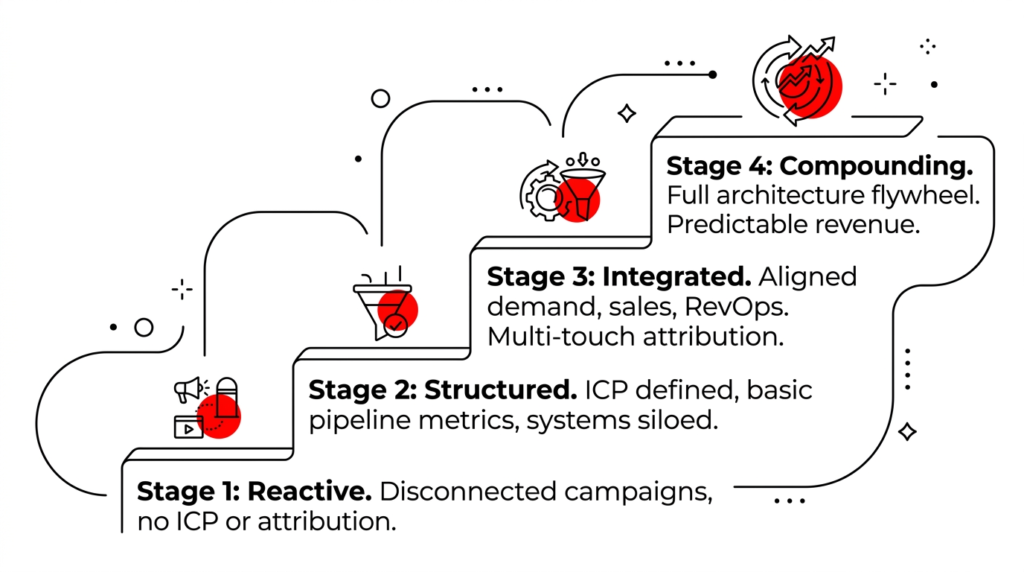
Most early-stage SaaS companies operate at Stage 1 or Stage 2. The priority at Stage 1 is ICP definition and basic pipeline instrumentation. At Stage 2, the focus shifts to connecting marketing and sales handoffs and establishing attribution. Stage 3 requires the full RevOps alignment described in this blueprint. Stage 4 is the destination: a revenue system that continuously compounds returns on every investment made in its architecture. The journey from Stage 1 to Stage 4 typically takes 18 to 36 months of disciplined, sequential investment.
Common Failure Modes in Revenue Architecture
Understanding what breaks Revenue Architecture is as important as knowing how to build it. The most sophisticated go-to-market designs fail not because of flawed strategy but because of predictable execution gaps that could have been anticipated and prevented. These failure modes appear consistently across B2B SaaS companies at every stage of growth.
Implementation Roadmap: 90-Day Quick Start
Revenue Architecture does not require a multi-year transformation before it begins producing results. A focused 90-day implementation sprint can establish the foundation of all five pillars and begin generating compounding returns within a single quarter. The roadmap below sequences the highest-leverage actions into three 30-day phases that build on each other progressively.
Revenue Architecture in the Age of AI and Automation
Artificial intelligence is not replacing Revenue Architecture. It is accelerating every layer of it. In 2026, AI-native go-to-market teams are compressing the time required to define ICPs, build demand engines, and optimize deal cycles by factors that would have seemed implausible two years ago. Understanding where AI creates the highest leverage inside Revenue Architecture is essential for maintaining competitive parity in a rapidly evolving landscape.
ICP definition is being transformed by AI-powered account intelligence platforms that analyze millions of company-level signals to surface lookalike accounts, buying intent indicators, and churn risk patterns with a level of precision no analyst team could manually achieve. The best revenue teams are feeding closed-won and closed-lost data into these platforms and receiving continuously updated ICP models that reflect real market dynamics rather than historical assumptions.
In the demand engine, AI is enabling hyper-personalization at scale. Content generation, email sequence personalization, ad creative testing, and audience segmentation that previously required significant human time can now be automated with quality guardrails that maintain brand voice and strategic consistency. The human role shifts from creation to curation and strategy, concentrating expertise where judgment genuinely matters.
In deal acceleration, AI-powered conversation intelligence platforms analyze every sales call, email, and meeting to surface coaching opportunities, competitive mentions, and deal risk signals in real time. Reps receive next-best-action recommendations. Managers identify coaching moments without listening to every call. Forecasting accuracy improves because AI-driven deal health scores provide signal beyond rep-reported pipeline stages. The result is a sales organization that learns faster, coaches more efficiently, and forecasts with higher confidence than any previous generation of go-to-market teams.
Measuring Revenue Architecture Success
Every investment in Revenue Architecture must be tied to measurable outcomes. The following metrics framework provides a comprehensive view of architecture health across all five pillars. These are not vanity metrics. They are leading and lagging indicators that reveal exactly where your revenue system is performing and where it requires attention.
Track these metrics at the cohort level rather than only as aggregate averages. Segment performance by ICP tier, channel source, rep, and deal size. Aggregate averages hide the variance that reveals architectural weaknesses. A 35 percent overall win rate that masks a 55 percent win rate on Tier 1 ICP accounts and a 15 percent win rate on everything else is not a healthy average. It is a resource allocation problem disguised as acceptable performance. Cohort-level analysis is what converts revenue data into architectural decisions.

Conclusion: The Architecture Advantage
The B2B SaaS companies that will define the next era of the industry are not the ones with the largest marketing budgets or the most aggressive outbound programs. They are the ones that have invested in Revenue Architecture as a strategic capability and built systems that compound returns on every dollar and hour invested in growth.
This blueprint has outlined the five pillars that every revenue leader needs to design and align: a precision ICP definition that concentrates resources on the highest-value accounts, a demand engine that creates consistent, qualified pipeline from multiple compounding channels, a deal acceleration system that converts pipeline to revenue with speed and efficiency, a RevOps foundation that creates a single source of truth for every go-to-market decision, and a scalable revenue system that gets smarter and more efficient with every cycle.
The path forward is sequential but not slow. Start with ICP definition and data foundations. Build the demand engine with distribution infrastructure. Engineer deal acceleration into your sales process with qualification rigor and buyer enablement. Align RevOps around clean data and attribution. Then step back and watch the system compound. This is not a sprint. It is the construction of a durable competitive advantage that becomes harder to replicate with every quarter you invest in it.
Start Now
Audit your ICP definition and CRM data hygiene this week. The 90-day quick start begins with a single honest assessment of your current architecture.
Move Sequentially
Do not try to fix everything simultaneously. Build each pillar in order and ensure each layer is stable before optimizing the next.
Measure Everything
Instrument every motion before you optimize it. Revenue Architecture decisions made without data are just expensive guesses.
Turn GTM Into a Compounding System
Align demand, pipeline, and revenue into one predictable engine.
Revenue Architecture is what turns B2B SaaS growth from isolated effort into a compounding system. When ICP, demand, deal velocity, and RevOps align, revenue becomes predictable, scalable, and far more capital-efficient.